Carlisle Cannons

The six 75mm Howitzer cannons that boomed at the Homecoming football game represent the resur­rection of a UTA tradition with a long (although somewhat fuzzy) past.

The firing of a cannon after football score has been initiated often as a spirit boosterever since the early 1940s when a salute cannon, dubbed Little Bertha, reportedly bellowed fire and smoke at parades and football games.

Her keepers were members of the Bull Pen Society, commuter students who were responsible for promoting school spirit when UTA was North Texas Agricultural College.

But Bertha’s description varies slightly. Some say she was a car­bide, muzzleloader.   Col. Joe M. Hill (’43) remembers the two-foot­ long cannon shooting 20-gauge shotgun shells. “She made a powerful lot of noise,” he recalled.

Regardless of her firing action, she garnered attention. Other college students were always trying to steal her, particularly those from John Tarleton Junior College in Stephenville, NTAC’s arch rival.  “It was like stealing the Baylor bear,” said Hill.

Sometime during World War II, Bertha disappeared. Some say she blew up, but others contend she was stolen.

After the war, a second Bertha showed up thanks to Hill who was collecting weaponry in Germany after the fall of the Reich.

In 1947 Hill had Bertha II bronzed and donated it to the military science department in honor of Lt. Russell Carrico and Lt. Constance Mims, friends of Hill who served as NTAC cadet colonels before the war.

The Bull Pen members again took over as cannon guardians, but this time the organization was comprised of cadets.

In 1972 Bertha II also disappeared or, as Hill put it, “some rapscallion stole it.”
Big Bertha

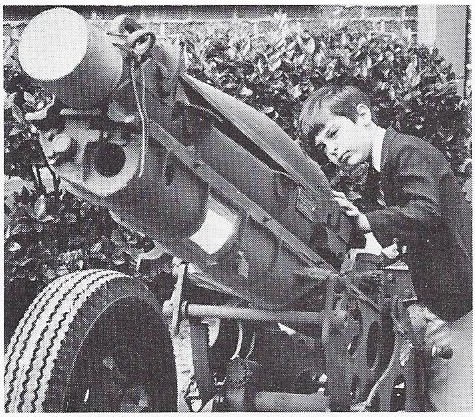
Several months ago, the current UTA cadet commandant Capt. Ron Munden heard that a surplus of “pack” Howitzers had been found in the far East. He requested six of them.

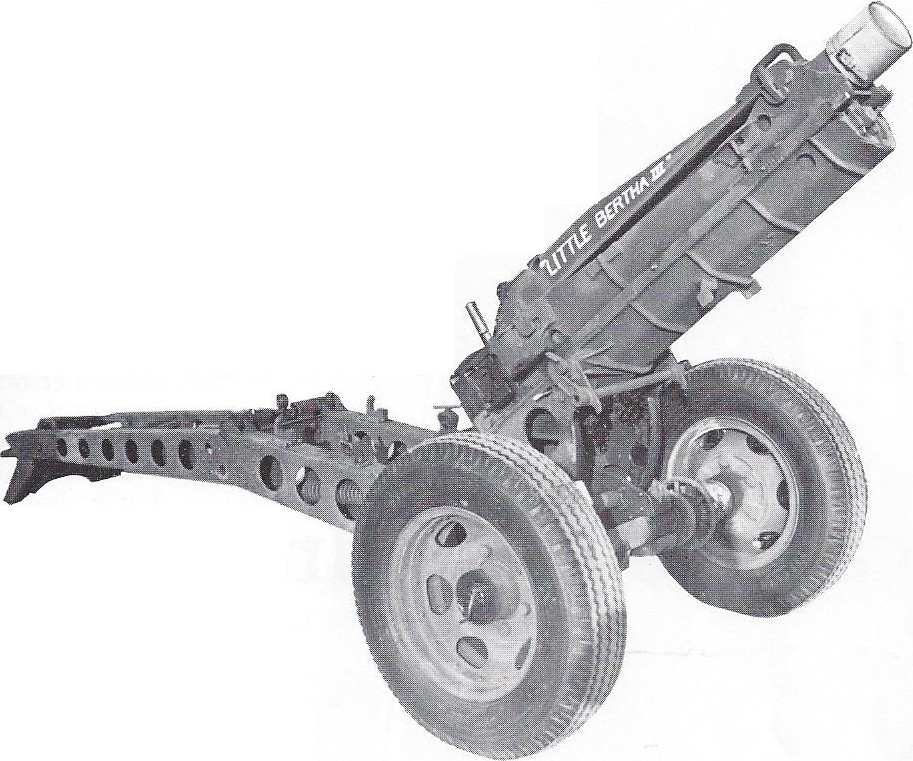
The oldest was dubbed Little Bertha III.

“She’s ours,” said Munden, noting that the other five are on a one-year loan, although he has re­ quested permanent custody of the big boomers.

That, he says, would give the military science department the only full salute battery between Fort Sill and Fort Hood, allowing use not only at UTA games, but also at any official ceremony requiring the military 21-gun salute.

As for Bertha III’s safety, the Bull Pen also has been resurrected and is responsible for her maintenance and safety. But it will take a hefty thief to haul Bertha away since she weighs about 1,400 pounds .

The new acquisition also has in­ spired a search into the cannons’ history. Munden wants to clear up the discrepancies about the muzzle loading versus shotgun shell can­ non and find Bertha I’s origins.

”We named this one Bertha III, but there may have been one or even two other cannons in there,” said Munden, who has assigned the Bull Pen cadets the task of be­ ing Berthas’ genealogists.

Any alumni with information about the cannons has been asked to contact Munden at (metro)

273-3281or write him in care of UTA.
 

In 1982, while serving on the cadre of the ROTC department at the University of Texas at Arlington, I came across some information referencing a cannon that the university had called “Little Bertha”. After determining that the cannon (s) over the years were very much a part of the university and its spirit, and being an artilleryman myself, I thought that it would be appropriate to try to replace the cannon and resurrect the history and spirit of Little Bertha (and Roaring Rebel, reported to be another cannon that the corps of cadets had in the past).

We began a search for a muzzle loading cannon, but determined that they were too expensive to purchase and we had no other way of obtaining one. On a whim, I contacted the US Army Armament and Munition Command at Rock Island and explained what I was trying to do. They referred me to Picatinny Arsenal. Picatinny told me that each ROTC detachment, upon approval, was authorized a Pack 75 howitzer, but none were currently available. They did tell me that some had reportedly been found in Japan and were going to be shipped to Picatinny Arsenal to be demilitarized. That I could contact them in about a year if I was still interested.

Almost a year later, I came across the notes that I had from my previous discussions with them and contacted Picatenny again. Luckily, I talked to the same individual that I had discussed this with a year earlier. He said that he had 126 howitzers in the demil process. I needed to work through Letterkenny Arsenal and Rock Island in order to received permission to receive one. After a lot of paperwork and phone calls, we received permission to receive the “donation” of the howitzer. I then contacted Picatinny with the approval and paperwork. They said that I had to submit a requisition through channels, but we had the lowest priority on the requisition (a 13).

All of that being done, I received a phone call from Picatenny that the requisition had been approved and how many howitzers did I want. I told them that we were authorized one. They said that was fine, but how many did I want. Being a true artilleryman, I told them that a 6 gun battery would be great; thinking that it would not be approved. The next week, we received shipment of 6 pack 75 howitzers (3 each on two flatbed trucks). They came in on a priority 3 requisition. I have no idea who changed the requisition priority.

We then began the process of getting approval from Ft Hood for the 75mm blank ammunition. That proved to also be a challenge, but eventually Ft Hood approved our request to keep us supplied with blanks, as we needed them. We also procured the blank adapters that allowed each howitzer to fire shotgun shells on those occasions that the 75mm blank was too much.

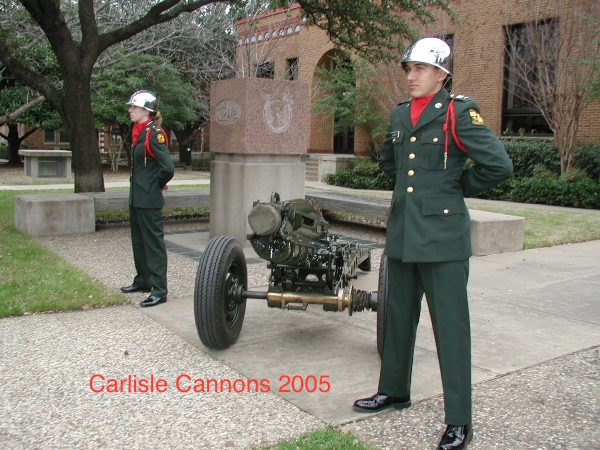
While all of this was going on, the cadets that were interested began forming the gun crews and an organizational structure. The name Carlisle Cannons was selected. Obviously, the first cannon was named Little Bertha IV and its crew was called the “Bull Pen”, maintaining the history of the past. Eventually, all of the guns were named; Roaring Rebel III, Molly Pitcher (from artillery lore), Gabriel, McAuliffe’s Reply, and Munden’s Muzzle (I was honored, but a better name could have been selected). The Carlisle Cannons were officially organized March 18,1983.

The cannons became very popular. They fired at all of the football games and obviously at Corps events. They also participated in official ceremonies for the Dallas Council on World Affairs (thanks to MG Latham), 1812 Overture with the Ft Worth Symphony, welcoming reviews at Sheppard AFB and Carswell AFB, various Dallas and Ft Worth parades and major high school ROTC functions. In order to provide the dignitaries with a remembrance of the salute, I was able to get full charge, empty brass canisters (free) from the National Forest Service, who use Pack 75’s with live ammunition for avalanche control. The cadets would clean and polish the canisters and I would engrave them with the UTA ROTC crest and the individuals name with the date of the event.

The Carlisle Cannon cadets had red satin jackets made with their name and Carlisle Cannons with crossed cannons silk screened on them. They also received permission to wear a crest, that they designed, on their uniform and a red cord on their class A’s.

The Texas National Guard provided either jeeps or flatbed trucks to transport the cannons to the events or pull them in the parades.

I was sad to hear that sometime later, the cannons were disbanded and then given away.

I still have some copies of a drawing that I did of the cannons and on of the jackets, crests, cords, etc. that I mention above, if you are interested. I also have some pictures of the Carlisle Cannons.


X