Stories & Legends

My first recollection of military life started when I was a mere lad of 7, making 25 cents a day for running hourly to the end of the Coast Guard ship refueling pier in Boston harbor to punch the time clock for the security guard, while he remained snuggled in his guard shack making time with my older sister. The money wasn’t bad and he let me wear his sailor hat.

Fast forward to fall 1962. I am a starry-eyed 18-year-old freshman at Arlington State College. A crusty old MSG named Dixon is selling me on the benefits of joining the ROTC Kay-Det Corps, not the least of which was having my pick of the litter amongst the campus lovelies. Not exactly what happened but close. I was hooked, and shortly thereafter I joined the ranks of the Old Sam Houston Rifles. I never looked back.

Following a semi non-spectacular 5-year career as a student, I received my commission in the Infantry and packed it off to Ft Benning Georgia, reporting for IOBC on 7 July 1967. I finished up the basic course and received accolades for my prowess as a “borne leader” of fine fighting men. Testament to that came on the eve of graduation when two of my classmates who had received battlefield commissions, one for action in the Ia Drang Valley with the 1st Cav and the other for equally intense service with the 1st Bde of the 101st Airborne Division, took me to the I-Bar for a celebratory drink. Little did I know that at that time no one was allowed into the I Bar unless he had a CIB and a Combat Patch? Trust me, had they not vouched for me it would not have been pretty. Years later, when I was “qualified” to be there I witnessed the beginning of the end of my army. I was there the day the first female officer was allowed in the place. The ensuing fracas was not pretty either. But I digress ,,,

Following IOBC I laid up sorry in the Black Angus Motel on Victory Drive in Downtown Columbus, Ga doing what every self respecting newly trained “killer LT” should be doing (And that is all I will say about that) until I was posted to basic Airborne School.

Following Airborne School and a short home leave I reported to the 2d Bde, 101st Airborne Division just in time to deploy with The Division to the Republic of Viet Nam. Now, Viet Nam is one of the most beautiful countries you could imagine. And the natives had this quaint custom of shooting at us and other such non-neighborly things. And that is what was charming about the place. What a helluva time that was.

During that tour I was assigned as platoon leader of the Security Platoon, HHC 2nd Brigade and later as a platoon leader in Co C; 1-502d Infantry Regiment (airborne). In September of “68 I was transferred to HHC, 1-505 Infantry Regiment, 3rd Brigade, 82nd Airborne Division.

At the end of my tour I was posted back to the US and given a choice assignment to the Presidio of San Francisco. At the time, probably the best tour of duty a soldier could have when not involving active combat. In those days, if one walked the streets of the Tenderloin or Haight-Ashbury in uniform one might think he was in active combat. But I wouldn’t know anything about that. I was assigned as Executive Officer of the Special Processing Detachment responsible for processing and pre trial confinement of all AWOLs and deserters collected throughout the 6th Army Area. I was later chosen over numerous officers senior to me to Command HHC, USAG Presidio of San Francisco. In addition to the doctrinal manning I was responsible for over 400 soldiers enlisted under what was known as “McNamara’s Project 100,00”. I also had a detachment of WACs assigned to the company. Highlight of that tour was when we established a perimeter fronting the main gate on Lombard Street and prevented the “flower children” from storming the gate. Like I said, a really great “non combat” tour.

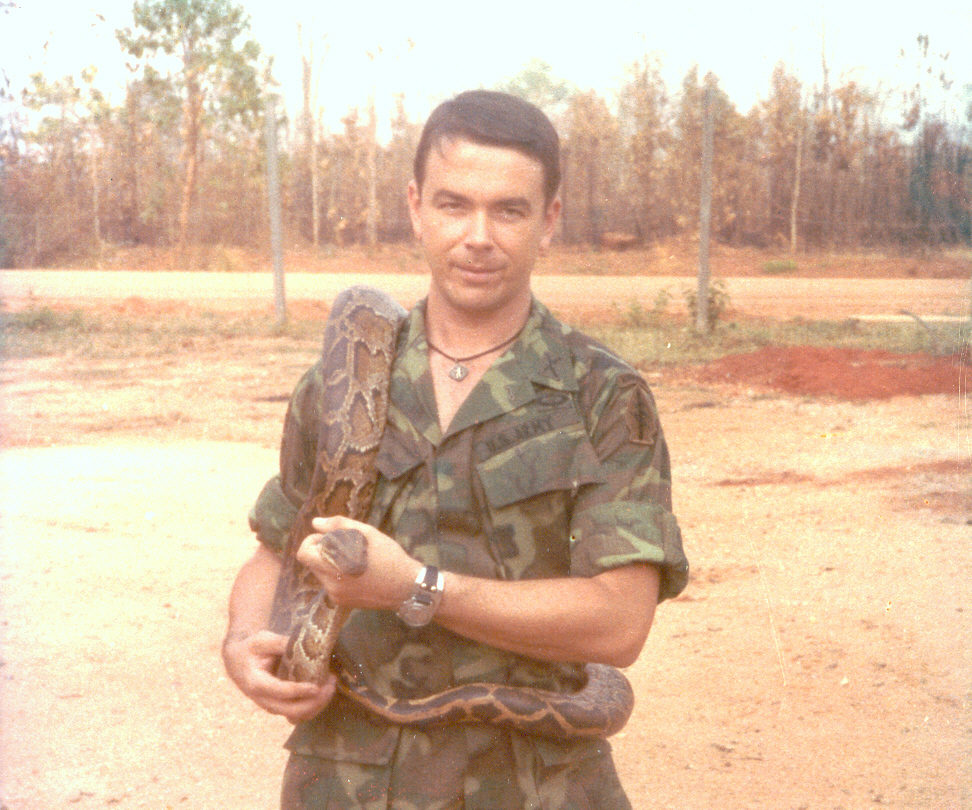
After 9 months of fun and relaxation I volunteered for a return engagement and was voluntarily posted back to Viet Nam in February 1970. I signed into the 173rd Airborne Brigade (Separate) for yet another “go” at the South East Asia live fire extravaganza. I was given command of the 24th Military History Detachment (which consisted of myself, a SP4 awaiting trial for some crime or another, a ¼ ton jeep and trailer, GP Small tent and a Royal typewriter). In just three short months me and my trusty side-kick documented the decimation of the 322nd Main Force NVA Regiment, not just once, but three separate times. We were so good that we successfully penned an award of the Silver Star for a Senior Officer for an action that took place while he was on R&R in Manila.

In June 0f 1970 I received the highest accolade any true Infantry Officer could aspire too. It was my privilege and honor to assume command of CO C, 2-503d Infantry Regiment (Airborne), a company of Americas Finest young men.

Following a return to the Infantry Officers version of Mecca, Ft Benning, for the Infantry Officers Advanced Course, I was posted (voluntarily) to 46th Special Forces Company (Airborne) in the Kingdom of Thailand. My initial assignment was as XO/S3 of Detachment B-461. That was followed by an assignment as Commander FTT II that consisted of two resident and three TDY Operational A-Detachments.

Then it was back to Fort Benning to spend what ended up as my last three years on Active duty. I spent time as an Instructor in the Small Arms Committee and as Commander, CO A, USAG. The highlight of that tour was my engagement (the first of a couple) to a lovely lady of the Philippino ethnic persuasion.

After being paid a handsome sum to leave active duty I spent most of my severance pay on wine ,,, women ,,, and song ,,, and sobered up three months hence in Hawaii where I joined the Honolulu Police Department.

Fighting crime was, in many ways, similar too and as much fun as fighting wars. Three years later the opportunity arose for me to take it on the road again, this time to Micronesia to “train” the local police department in the ways of modern crime fighting. That gig lasted for three years during which I also served as Executive Assistant to the Governor. After marrying my second Phillipina fiancé, we returned to Honolulu in 1982 with our son and settled in for the long haul.

I took a full time job with the Hawaii Army National Guard, which I kept for 14 years, serving in a dual capacity as technician Monday to Friday and as a drilling Guardsman in the 29th Infantry Brigade (Asst S3 and S4); S2/3 and XO of the 159th Maintenance Battalion, later re-designated as Support Battalion, 29th SIB, State Mobilization & Readiness Officer and State Training Officer.

I transferred to the US Army Reserves in February of 1990 serving in positions of varying importance and degrees of difficulty to include Instructor and S3, 4960th Multi Functional Training Brigade; NE Asia Desk Officer, Pacific Army Liaison Command, and Commander of the 4960th MFTB.

My tour as 8th Military Support Officer, wherein I was responsible for planning and coordination of DOD support to civilian first responders in times of natural and man made disasters, prepared me well for my last tour of active duty heading up the Homeland Security/Defense efforts for the Islands of Hawaii and surrounding territories. I performed that function until I reached mandatory retirement on 1 July 2002. On 3 July 2002 I was recalled to active duty in retired status to complete the mission. I retired for the final time on 1 July 2003.

My civilian position as an Exercise Coordinator for US Army Pacific requires that I travel extensively to South East Asia, where I am responsible for planning and conduct of bilateral Army-Army training exercises with Malaysia and Singapore Armed Forces.

I proudly earned the Combat Infantryman’s Badge, the US Airborne Qualification badge, and Royal Thai Special Forces Airborne Wings. Over the years I was given the Legion of Merit; Meritorious Service Medal; Bronze Star w/V device; and a few other miscellaneous awards, decorations and promotions.


Written by Colonel Joel Ward, Ret. about 11 November 2004.
I experienced something when I was as DFW Airport the other day that reverberated deep within my consciousness. I was there to take my granddaughter to fly to Pittsburgh. She was 12 and flying alone. I was allowed to escort her beyond the security checkpoint to the gate. We hugged, kissed and she boarded her flight.

As instructed, I waited in the departure lounge until the flight left the ground. The intercom announced that there was a special flight arriving from Iraq with soldiers returning home for rest and recuperation. I went to the window looking out at the tarmac. Everyone in the lounge joined me. Sure enough there was a jet marked “North American” along its fuselage. It was stopped away from the gate. Then I noticed fire trucks parked about fifty feet away from the left and right of the aircraft. The intercom announced that the firefighting equipment was performing a “welcome home” for the returning heroes. The trucks began their water streams above, but in front of, the arriving aircraft. On queue, the aircraft began to roll to the gate passing under the two arches of water. I have not seen this recognition mentioned in the news or advertised. They just do it. How wonderful it is — a sincere, heart felt expression of thanks.

From a distance I watched the soldiers deplane, many meeting their loved ones. With a lump in my throat, I tried to congratulate a few of them, but they were busy reconnecting with family. I left the airport feeling very good for our returning heroes.

Driving home, I thought about the experience. It occurred to me how our country has evolved. I truly believe that our society has become more sophisticated and discerning in its judgment of world situations. I am sure that some of the people welcoming the soldiers did not agree with the war in Iraq and yet they welcomed the soldiers as returning heroes. They made the distinction between national agendas and the role of the soldier.

This is drastically different from my experience when I arrived at San Francisco International Airport in 1966 from Vietnam. In the required uniform, I departed my flight and entered the terminal. Bleary from seventeen hours of flight and twelve months of combat, all I wanted to do was connect to a flight to Peoria to join my wife and son. I wasn’t paying much attention to the crowd in the airport until a long haired, bearded young man approached me and said I should be ashamed of what I was doing and then spat on me. It made me realize that I have a deep seated emotion about how America in general treated Vietnam returnees. I am told that many other Vietnam vets feel the same. They were neither greeted nor shown appreciation for their sacrifices until over twenty years later when the Vietnam Memorial was established on the Mall in Washington, DC.

Most Americans are now more aware that there is a difference between implementing a national strategy and enforcing that strategy with soldiers who go into harms way. Today, they know that these soldiers have patriotically volunteered to protect America and are merely following legal orders given them.

What is different now? In both wars our leadership perceived that we needed to combat a threat quickly. Arguably, delaying the military option could allow the situation to worsen while pursuing diplomatic solutions (many of which had already failed). Ultimately this could cost the United States more in people and money. It appears that today’s leaders believe that they must be decisive and don’t believe they have the luxury of time to determine the national will. No matter which side you take, this is a very tough call.

Americans are much better informed today. Some of the credit should be given to our government for allowing correspondents to be imbedded. Also, much of this increased understanding should be given to the media. Collectively, they have personalized the story of the citizen turned combat hero. When I was in Vietnam as an advisor to Republic of Vietnam (RVN) forces, I never saw a reporter. The news coverage I saw between Vietnam tours was mainly of U.S. military units fighting in the highlands up north. Even that coverage was by reporters who usually stood in front of various military headquarters and not on the battlefield. Technology of the times delayed video coverage by about two days. Although we could argue that that news coverage might be biased, improving technology, an aggressive media, and military willingness to let it all be covered has kept America better informed about Iraq.

To those Vietnam veterans who feel that they should have been welcomed like this new generation is being welcomed from Iraq, I say, you’re right, but let’s move on. At least these heroes are being welcomed with pride. That’s progress! I am convinced we are a much better country today than we were.

So, THANK YOU, DFW Airport.

And to today’s combat veterans a most heart felt THANK YOU.

And THANK YOU, ALL AMERICANS who understand and distinguish between our national agenda and the commitment, dedication and bravery of the American soldier. We should all be extremely proud of this generation and its commitment to duty, honor, country.

Thank you,

Joel H. Ward
Colonel,
US Army, Retired

[Back to Stories and Legends]

Born in Sedan, Kansas May 28, 1929, we came to Texas two years later when my father was employed by the Sun Oil Co. during the East Texas oil boom. We lived in Sun Company’s camp, which was off highway 80 four miles east of G1adewater, and ultimately consisted of approximately 40 houses. We attended school at White Oak through my freshman year when, in 1943, Sun Co. sent us to Hebbronville – a town of 1500 people fifty miles east of Laredo. Our graduating class of 1945 was the largest in school history (J8) with eight Anglo boys – no girls. Five of us checked in at A & M the following fall where I met an NTAC graduate who told me about the school’s Industrial Aviation Engineering course. That sounded like what I was looking for, since I had always been an aviation enthusiast, so I left in December and enrolled at NTAC in January.

At that time total enrollment was about 2500 with most of those being commuters (Day Dodgers), including veterans on the G.I. Bill, so the number of students living in Arlington was small and close-knit – everybody knew everybody. The PMS, Colonel Keltner, had been a POW in the Philippines with the well-respected General Wainwright who paid us a “promotional” visit. The Sam Houston Rifles was reborn with David Sullivan elected commander — myself executive officer — and the unit represented the school well with our appearances in the “Battle of the Flowers” parades in San Antonio and our impressive burial team that presided over the final internment of KIAs from WW-II. Ray Price (before Cherokee Cowboys) was on campus in a naval aviation program, Morgan “Doc” Woodard (“No Eyes” in movie Cool Hand Luke) sang with us in the bass section of the choir, which also toured. In the dorm we had Dick Scott who is an accomplished senior citizen athlete, Dick Cavasos, Willard Latham, and Elmus Ussery who became generals, so NTAC, to be so small, cranked out some big successes.

My brother Pat enrolled in the fall of 1948 after my May departure. He and some other cadets subsequently joined the Marine Reserves to make some easy money, and then came Korea and the Reserves call-up in June. I drove from Silver, in West Texas, to Dallas Naval Air Station (Grand Prairie) to “see him off” and, upon hearing they had an empty slot in their unit – I filled it.

In August the unit (VMF-Ill) flew to El Toro, California where we were dispersed to bring various squadrons up to operational level. Pat, being a line mechanic, was sent to a fighter squadron and I, having no M.O.S., talked them into assigning me to the Combat Information Center in a radar outfit. Considering my oilfield experience, they wanted to put me to operating heavy equipment. I countered with the reminders of my aviation education and pilot’s license and, luckily for me, they relented.

In October orders came to send everybody who hadn’t been, to boot camp. Our platoon in San Diego consisted of 70 reserves from nearly every state, including Hawaii. After asking for people with R.O.T.C. experience the Drill Instructor chose a guy from Virginia Military Institute, Pat, me, and one other, for squad leaders. After three weeks at the Recruit Depot we moved north to Camp Matthews – rifle and weapons range. One day a few of us were ordered to report for interviews in a Corps-wide search for the most “Gung Ho Marine”. Since Pat joined for the money and I had just gone to visit and say “Adios” our candidacy probably never got off the ground. The interviewing officer (a Reservist also) turned out to be a petroleum engineer for Exxon and worked about 30 miles from my job with Sun Oil Co., so we had a friendly chat. He noticed in my bio that my father’s name and address was the same as the previously interviewed Brown. He said “Are you brothers”? Until now only the “boots” in the platoon knew the answer – not even the D.I.s. We had kept it quiet to prevent possible separation. He was amused by this, and then suddenly turned serious. He asked what I knew about the “KKK”– I said “nothing”. He said your brother’s bio includes ‘KKK’ as one of the organizations of which he’s a member”. I smilingly explained that the Kampus Kadets Klub was a local campus organization — not national, like fraternities — and shouldn’t have been on the biography. He was checking my story against Pat’s, I guess.

Pat had quarterbacked Hebbronville’s football team for a couple years, so on the day we went to hand grenade familiarization, he threw the grenade (like a football) over the pit and the opposite berm – out of sight. The instructor, surprised at the distance, asked why he threw it so hard. His reply was “He didn’t want to be close to it when it went off”. Maybe an overdose of adrenaline?

We returned to San Diego and subsequent graduation. Our platoon was designated the “Honor Platoon” of the class and Pat and I were designated “Honor Men” of the platoon. Normally there is an “Honor Man”, so this novelty was probably prompted by the potential P.R. that might be gleaned. All the N.T.A.C. cadets in the platoon left their mark on the Ohio D.I., and he was grateful.

We returned to our squadrons and ours was transferred to Camp Delmar (near Oceanside) where, in May, I was one of fifteen survivors of the capsizing of an Amtrak during a training exercise. We lost five. I volunteered for duty in Korea after which I was released from active duty in August 1952 – Pat in February 1952.

He returned to Arlington and became Corps commander. I went back to my job for about three years, then hired on with Baroid Well, logging and drilling fluids for eleven years, working in eight different states between here and Washington in the first twenty months. The remaining years were spent on the Gulf coast and offshore. I joined Union Carbide in 1965 and spent the next 22+ years at their Seadrift (TX) plant, retiring there.

We’ve lived in Port Lavaca since 1961 and took up RV camping in 1965, having since covered the U.S. mainland and Alaska. Now most summers are spent near Rocky Mountain fishing lakes.

We have a son, a daughter, five grandchildren, and a great-grandson. One grandson went through Army airborne and ranger schools, did a tour in Korea, and Bosnia, and is now a civilian in Germany. Two grandsons are in the Air Force. Our only granddaughter, Ginny Leigh King, just graduated in architecture at UTA – she is our guide when we visit the campus since I can’t find the campus I left. But the memories are still there.

[Back to Stories and Legends]

By Bunky Garonzik
New Braunfels, Texas1977…
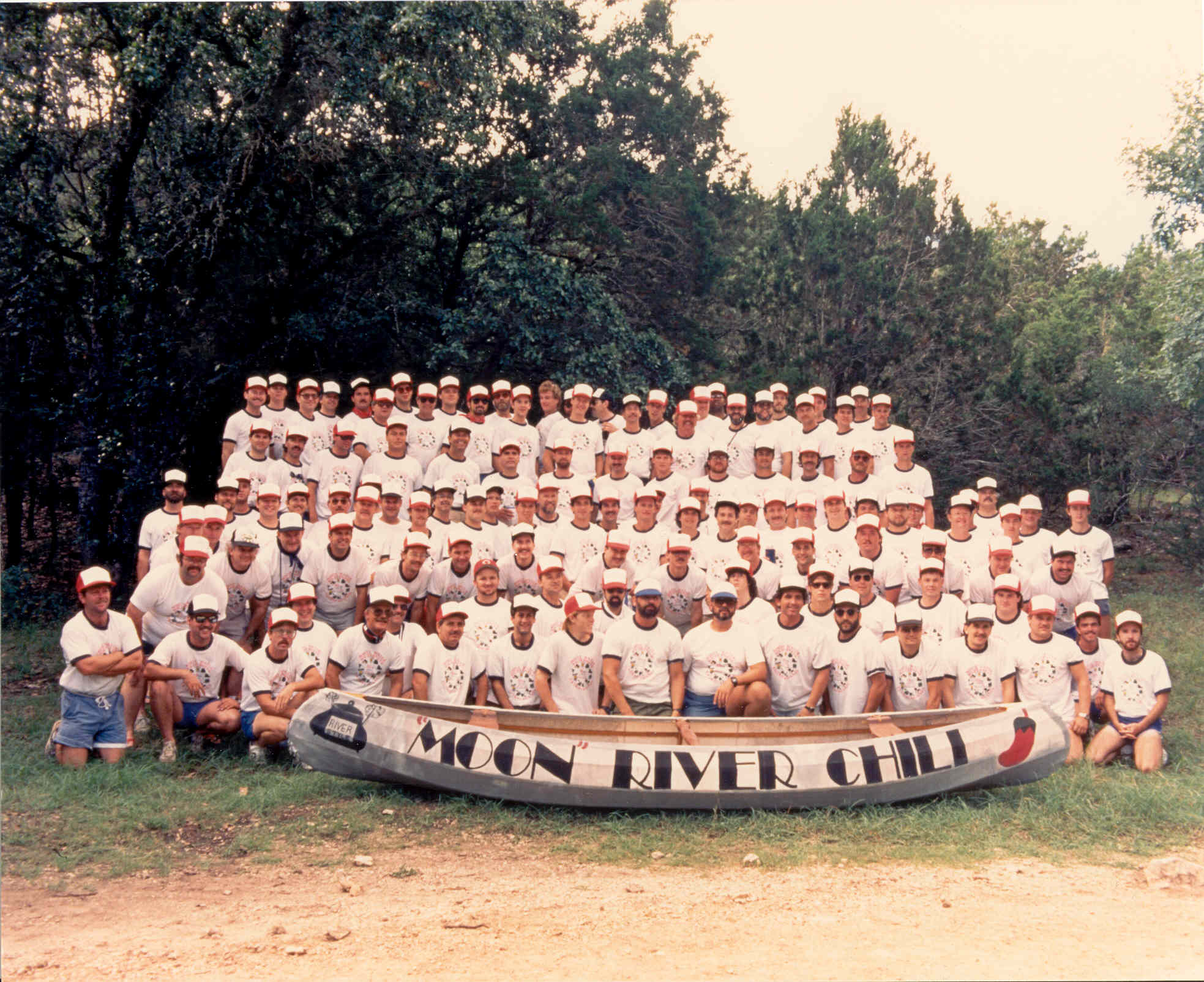
Inspired by the movie Deliverance, a group of hard core Jody alumni adventure seekers decided to try our hand at white water canoeing. The twelve of us pitched a few tents, drug out a few coat hangers and hot dogs, and I made a pot of my world famous Chili. For you land lubbers out there, you should know that river rapids are classified from 1 to 5 with 5 being the most dangerous. That year, the river was about a Category 2. The next year, in addition to more Jodies, a few brothers-in-law and a few neighbors joined the group. There were 33 obnoxious guys, with McBee heading the list.
As the crowd grew, the food got better, the river got faster, the tents gave way to some motor homes, and we even allowed a lawyer or two. By year number three, we got event hats, T-shirts, and participation certificates. The numbers grew. Awards were given for Best Joke, Best Hat, Best Cliff Dive, Best Camper, Best Meal, and the coveted River Rash Award. The opening hand for this award was blood or a broken bone. Points were added for stitches. In one case, a veterinarian canoeist on the trip administered the stitches. The stitches were later removed in his office while sitting next to a German Shepherd. 8 x 10 color photos of the group were taken and mailed to the participants in a plain brown envelope. The group reached a body count of about 150 guys. The river reached a Category 5.
Far too many of the guys competed for the River Rash Award. Floyd Wine lapped the competition when he did a double off the 80-foot cliff dive with streamers soaked in kerosene flaming off his legs. Conquering a Cat 5 with no KIA, will bring a group together like a bunch of guys sharing a foxhole during a firefight. We were bullet proof and invisible.
We were clearly out of control! The energy and anticipation for the river trip began ramping up immediately after we returned from the previous trip. Scantly clad girls showed up at our camp sight looking for a souvenir T-shirt, a gourmet meal, or a spot at the Joke-Off and the awards ceremony. Divorces were filed. Children were swept off the street and kept indoors. The cops circled our camp sight at night. Our annual visit to the area created a Condition Orange posting in Comel County.
The group photograph was published in Playboy Magazine. Why Playboy? To answer that question, you need to look up the February 1984 edition. While McBee and I were the only ones to make all fifteen trips, guys like Rudd, Dulaney, Brazeil, Thompson, McEwan, Mike Ellis, Campos, Klemme, Pink, Reyes, Closner and Wine all had double-digit participation.
By 1992, the fifteen years as well as the river had run its course for me. (S-3 was never my true passion). Some of our kids who were three years old when we started, were now 18, and made this last trip. My curly black hair and beard gave way to a shiny spot and an additional 20 pounds. Liability and lawsuits crossed my mind for the first time.
However, for the Jodies and all the other members of the group, these canoeing trips will be forever etched in our memory. It is amazing to discover what happens when you dump the Rolexes, the BMWs, and the monogrammed shirts and issue the bankers, the truck drivers, the school teachers and the judges a T-shirt and a ball cap. Pretension is eliminated. Equality in its purest state is achieved. Peace, tranquility, and understanding Nature become a reality. Male bonding at the highest level. Well, forget the peace and tranquility part.

[Back to Stories and Legends]

Story by Allan (Bunky) Garonzik

In the olden days, the car that we drove identified many of us. The vehicle reflected not only our personally, but often our social status, out ability to get dates, our priorities, and, put into simply terms, just how Kool we were, or were not! The cars were named—Joe Billy Swift, had the Bullet, Willy Riggs had the Skunk, Lucifer Smith had the Spider, Rendleman had the Mayflower, Mike Ellis had the Goat—well, you get the idea. You remember the drill. Many of us spent more hood time than windshield time. As the cars progressed in technology, this right of passing all but faded away. All cars now are pretty much the same—void of personality. Nobody knows how to work on cars. Most young kids today think a Phillips Screwdriver is Milk of Magnesia and Vodka! Kool nowadays means paying $160 for a pair of Nikes that cost $6.00 to produce in Bangladesh, or a pair of shorts that won’t fit properly until you are a couch potato at 38 years old.

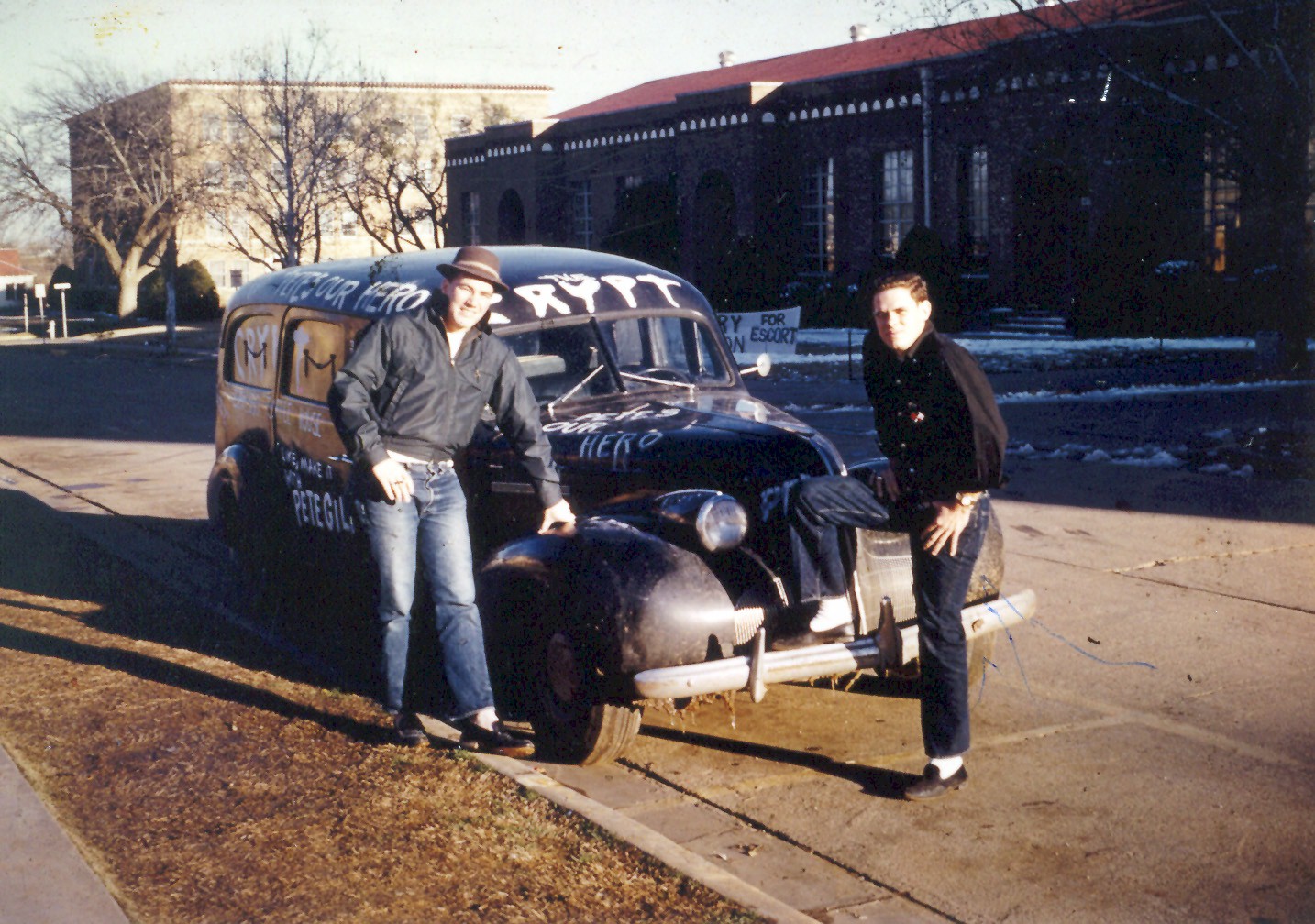
From those thrilling days of yester-year (around 1960) Fred Yarbrough offers this story: (Fred was a young Jody, Military Science student, hard working, with an unusual 3.2 GPR seldom found amongst the drill team types.) James Carter was willing to part with his 1940 Buick Hearse. It had a straight 8 flathead, a manual 3 speed with really tall gears, similar to a Lincoln Zephyr, and those dreaded babbited rods. None of this means anything to anyone born after 1960, but the point is that the babbit rod bearings had to be changed from time to time. Normally not a problem on a Hearse because, after all, it wasn’t designed for high mileage, fast speeds, or radical driving. Guess what? General Motors didn’t consider Chuck Molinda, Tommy Thomas, Yarbrough and Rendleman when they designed the Hearse. The Arlington Police and the Campus Cops hated the sight of the Hearse—with its graffiti painted all over it: “Why go around feeling half dead, when we can bury you for $49.50”, and “Come on in, its cool inside”, and “You stab ‘em, we slab ‘em. You get the picture. So when the hearse needed an overhaul, what better place to work on it than the parking lot in front of the SUB with its concrete parking lot rather than the gravel lot of Davis Hall.

Off to what is now Deep Ellum for the two week wait for the rods to be remanufactured. All the while the Hearse is up on blocks, which some narrow-minded folks thought to be an eye sore. Electricity was needed to hone the cylinders, (Fred informs those who think a Spark Plug is a new brand of Chewing Tobacco, that honing a cylinder is the process of preparing the engine for the new piston rings to ‘seat’). Naturally, the nearest source of power was in a classroom. Not just any classroom, but, by design, the classroom of Professor Doctor Barron White (as he insisted on being called). One of the guys involved in the overhaul, wearing very greasy cloths, strolled into the eccentric professor’s classroom dragging an extension cord, and announced that he needed some electricity. Noting the agitation of Dr. White, this process was repeated for several days. (A Chinese economics professor who kicked me out of his class for laughing when he butchered the word “fluctuation” eventually replaced Dr. White—you may have to think on that one!) The big Buick ran like a top and was eventually was sold to a coffee house called the Crypt, but not before the ASC Student Handbook was modified to read: “There shall be no vehicles taken apart for the purpose of overhaul on campus”.

As was often the case with these college antics, the players, more often than not, turned out to be contributors to society. Swift, Rendleman, Lucifer, and Riggs took their Senior Trip to RVN, and Yarbrough became a Captain on Eastern Airlines having successfully completing the exact same number of landings as take-offs over his 25-year career. It is no surprise that Rendleman, and Yarbrough are still building award winning street rods even though, at their age, they often forget where they park their cars!

[Back to Stories and Legends]

By Allan (Bunky) Garonzik

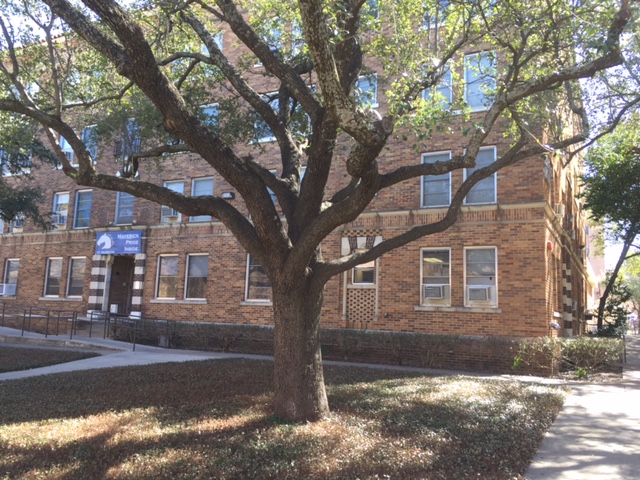
Located on the most Northeastern point on the UTA Campus, Davis Hall has withstood the test of time, and, by all rights, should be designated a Historical Landmark. Yes, the name has changed over the years, and other buildings on campus have taken the name Davis Hall, but the “real” Davis Hall lives on. As a matter of fact, it will always be there. It is indestructible, and can’t be torn down. Lord knows, throughout time, many have tried and failed. Designated a Military Dorm for decades, Davis Hall was the temporary home for scores of cadets in the ROTC program. The footprint of the building actually forms a large ‘L’, made up of four cubes, or Ramps. The ramp forming the apex of the ‘L’ had no back door. The structure is steel. The walls are concrete. The floors are Granite. Added strength was gained through a honeycomb space between the ramps. Access between the ramps was only possible by leaving the building and entering the bottom floor of another ramp. Not so fast, Scott Leidolf! The steel medicine cabinets were easily removed, and a nimble cadet could scamper between the walls of the different ramps, but I’m getting a little ahead of myself.
Young folks are impressionable, and when I came to Arlington State College in the Spring Semester of 1961, I was no exception. I wanted to fit in. A room on C Ramp was assigned, and I met a guy who would become the first of my three roommates at Davis Hall. Mike Ellis was a tall skinny kid from Temple, Texas with big glasses lots of teeth and a head that resembled a Cantaloupe. Many of the ROTC types had the reputation of being geeks. Mike smiled and looked at me with an expression of, “What the Hell kind of card did I draw this time?” Many a plot, plan, and caper would be concocted in that tiny room in Davis Hall during the 60’s. We would work together at 6 Flags as Confederate Soldiers, & Gunfighters, and later as Buyers at LTV plus various Christmas jobs. We become best of friends for over 40 years.
Within minutes of drawing out my uniforms, I ran into Ron Rendleman, my idol and mentor. Ron was a senior and a legend both in ROTC and Davis Hall. I had known Ron since I was 5 years old. I followed four years behind him my entire life—model airplanes, scouts, motorcycles, boats, hot rods and now, ROTC, Davis Hall, and the Jodies. Later, we would own an airplane together. Ron said, “ Suit-up and lets go!” I had no clue what was in store, but I knew if Ron were involved, it would be fun. Parked in back of Davis Hall was some type of armor military hardware. Rendleman had talked a military salvage company into “donating “ this vehicle to the ROTC with the condition that when it was returned, the motor would be overhauled, and the vehicle would be working properly. Lee B.Wilson, chomping a green cigar, was perched on top of this tank-like vehicle. “Get the lead out, cadet!” Off we went down the streets of Arlington. Traffic yielded, red lights were run, pedestrians were impressed. I knew that life at Davis Hall was going to be good. After an hour or so taking out small trees in some field and seeing how far the vehicle could stay airborne, we returned the smoking armor to the parking lot. Wilson would become a Green Beret, and Rendleman would become a highly decorated Chopper pilot. I had yet to spend the first night at Davis Hall!
As with any military situation, there is a T.O. & E (table of organization and equipment). Davis Hall was no exception. There were ramp commanders and a dorm commander. These positions were filled by the upper classmen who made good grades, did well in ROTC, followed orders and, above all, kissed ass. Cadets who had the best opportunity to excel in their military career were chosen. Our dorm commander was Norman—not “Stormin’ Norman,” but “Abnormal Norman”. He ruled with an iron hand. We were able to run Norman off after one semester, and he disappeared into obscurity. Mission accomplished.
The episodes surrounding Davis Hall shaped our young lives, and those that preceded and followed. These capers will be forever etched in those hallowed walls. Here are a few stories during my tenure. Because B ramp was the only ramp without a back door, it was chosen to fill the front porch and recessed doorway with packed snow after the first good snowfall. No one considered firetrap or any danger to be part of the equation. Seeing the cadets climb out the windows and scale down the walls to get to class was reason enough for the prank, and expression of our excitement with the fresh snowfall.
Sometime in about 1962 a young punk named Gus Rae showed up at the dorm. Brash and arrogant, Gus made the mistake of saying, “my name is Gus RAE-(spelling out R A E ), and don’t you forget it.” We didn’t! In those days, the Mennon after-shave folks came to the campus and distributed little sample bottles of their product. Naturally, we all filled up our medicine cabinets. That night, Scott Liedolf, my second roommate, volunteered to take care of Gus. By removing our medicine cabinet, he was able to climb between the walls to the adjoining ramp and duct tape an M80 to the back of Gus’s cabinet with a cigarette attached to the fuse. Within minutes of returning safely to our room, an explosion could be heard all the way across campus. The medicine cabinet ended up in the middle of the room and the entire ramp smelled like a French whore house. That’s R A E!

I have to leave the names out of this one because this caper is still open on the books with the FBI. Gus’s room was not the first to fall victim of an explosive device between the walls of Davis Hall. A few years prior, the same technique was used, but this time, the device was a 105 Simulator. You military types know this is a BIG explosion! Lucifer Smith was shaving at 3 am when the explosion occurred. His instinct caused him to hit the deck as he heard the distinctive whistle just prior to the explosion. His medicine cabinet set sail—along with about half of the plaster from his wall. Most of the rooms of two adjoining ramps incurred the same damage. When the FBI arrived (the 105 is a military device), one cadet was still laying motionless in his bunk covered with dust and plaster. They thought he was a gonner, but actually, he just went back to sleep. This little prank was clearly over the line. It took many years for me to realize that this stunt, along with taking out an airplane with a 2 x 4 through the propeller (reported in a prior issue) are examples of pranks that simply shouldn’t have taken place.
In the old days, many of the Davis Hall residents were fresh off the farm. They came with some valuable 4H knowledge not often found in the Park Cities. For instance, I’ll bet most folks don’t know that you can get a full-grown cow to walk up to the fourth floor of D ramp with only a slight tug of the rope. Hell will freeze over before the cow will walk down those same stairs. There are two sure fire methods to get the cow down. One requires a butcher, and the other requires a harness and a crane. A collection was required to come up with the necessary funds for the crane.
Another frivolous, fun-filled fact found first and foremost around the farm, is that chickens will survive quite nicely throughout the two week Christmas Holliday in Dave (Possum) Murray’s room if you leave them plenty of feed spread throughout the room. The random pattern of their droppings has kind of an artistic appeal after 14 days. Dave signed up for C ramp commander, and became fair game. Speaking of game, Ron Watson gets credit for bringing the road kill possum from Lake Arlington and hiding it in Murray’s room for a few days. I was assigned the task of bringing the ripe Possum to the dumpster with a pair of pliers, but the stream of Jody young men who got to climb in the dumpster got the worse end of the deal.
The question of what to do with old issues of the Shorthorn (the college newspaper) comes to mind. The obvious solution seemed to be to wad up the paper, and see how many loads it would take to fill up the fourth floor of A ramp. Now, the burning question was of how to get rid of the paper. Eddie Osburn decided to do just that. The fire department was not very happy about that caper.
One may ask, how on Earth are all these pranks part of the college learning experience. What possible benefit could be achieved? I can answer that. For instance, if you place a stiff piece of cardboard on an angle towards Ray Jollisant and Terry Moore’s dorm room and pour five gallons of used crankcase oil down the cardboard, at least 97% will run into the room. This is a law of physics. If the Granite floor is level, and depending on the temperature and viscosity of the oil, a near perfect circle of approximately 12 feet can be achieved.
Joe Billy Swift and Henry Aerioga were roommates, and both were members of the Rifle Team. Joe Billy could shoot a group of 12 at 300 yards and cover it with a dime. The only guy who could do better was Lanny Basham who got a street named after him after he won the Gold at the Olympics. In association with their studies, Joe and Henry wanted to determine the penetrating power and deflection of an arrow through the solid doors of the crapper of two adjoining dorm rooms. In the interest of safety, a volunteer was picked to witness the arrow’s flight through the doors from inside the crapper—out of the line of fire, of course. To further reduce the risk of an errant arrow, one of the bunk beds was placed vertical behind the second door with the government issued mattress safely duct taped into position. They couldn’t use Rendleman’s bed because it had a 35 horsepower Evenroud outboard motor attached to the bed frame. Yet another practical application to what may, at first, seem a little on the crazy side. Joe later served a few tours in Viet Nam—both as an Infantry office and later as a helicopter pilot.
Possibly one of the most practical physics experiments in Davis Hall’s history took place in the Spring of 1963. The plan incorporated all the elements of a military exercise and academic skills needed to train Army leaders. This caper required intense planning, a precise list of materials, training, coordination, and a worthy target, with minimal collateral damage. The goal was to determine how long it would take to fill a dorm room with 4 inches of water. (This was the height of the granite dam between the room and the crapper.) Adding to the challenge were several additional elements; the occupants of the room would need to be there but not know what was going on, it had to be done at night with no lights, and we didn’t want to destroy any personal belongings. Picking the target was the easy part. Anyone who knew Carl Joe Weatherby would fully understand. His red hair alone was sufficient cause to make him a target, not to mention his attitude in general. Unfortunately, his roommate was Al Ellis-the Jody Commander, the Corps Commander, good student, mister clean, etc. Oh well, casualties of war happen. We entered the room at 02:15 hours by a pass key. (For those who went into the Air Force, that is 2:15 in the morning) While I caulked the pipes that penetrated the granite floors between the rooms below, Lamkin attached the hoses to the two lavatory faucets, and secured them with clamps. These hoses were cut to a length that allowed them to run across the floor for about a foot. The trash can was placed on the hoses to insure they would not flop around. The faucets were the type that had internal springs to insure that the water would not remain on. Pitz, Ellis, Leidolf and Herr silently started removing every piece of furniture as well as books and clothing. These were stacked in the hallway. Garrett sealed the space between the front door and the floor. With the room now empty except for a trash can, a steel bunk bed, and two sleeping cadets, Watson installed the pre-cut wedges to insure the proper amount of water would flow. The patrol exited through the crapper and adjoining room on schedule at 02:22. The goal was to obtain the calculated 4 inch water level by 07:30 hours—the time the cadets would wake up to go to their 8 o’clock class. I accept full responsibility for the flawed plan. The alarm clock was in the hall with everything else. As the morning sun awoke Al at 08:15, he glanced at his watch. (Expletive deleted). They hit the floor with a splash and a splat. By now, the water had breached the 4” mark where the door was sealed and was headed down the stairway. As their good buddies, and fellow Jodies we all pitched in with brooms and mops and helped clean up the mess. Who would do such a thing?
And the times, they are a changin’. Today, these types of stunts would land you out of college and likely in jail, but I’m not so sure that these exploits and capers put such a negative spin on how our lives have turned out. We all graduated from college. Lamkin, Garrett, Rendleman, Swift, Al Ellis, Pitz, Moore, Jollisant, Osburn, Lucifer Smith, Lee Wilson and Murray were all commissioned officers. Most were decorated. Pitz went on to the FBI, Herr became a doctor, Al became the president of the Dallas Bar Association. Scott and Mike Ellis have been successful in business. Heck, I even went to Graduate School at Tulane, started a few businesses and retired at 50. I now spend my time volunteering for the leukemia society and supporting several other charities and writing crap like this. I take full responsibility for any errors, fabrications, and embellishments. [email protected]

[Back to Stories and Legends]

By Ned Allan

It was the Fall Semester of 1962. The Corps of Cadets were a voting block to be reckoned with on campus at Arlington State College. Nationwide, lines in the sand were starting to be clearly drawn between the two factions of Military and Nonmilitary students. The war in Viet Nam was daily headline news. Protests, Kent State, and burning ROTC Armories, Draft Cards and American Flags seemed to be the order of the day. At ASC, the Sam Houston Rifles, or Jodies represented the most radical of the “Pro-Military” movement as they were nicknamed. Not only were they the best in the land when it came to precision marching, but hard core in dedication and physical stature. The Jodies were campus leaders, future heroes, career Army officers, and the team had a tradition of excellence as the oldest organization on campus.
The other side of the coin, the Jody counter parts, or adversaries, were the Fraternities. Their purpose in life was to party. They dressed and acted in stereotypical fashion. They wore the latest in clothes and fashion with “Gentlemen Quarterly” hairstyles. No real goal or direction, these young men sought to become successful in life by a network of “who you know”, or “good old Frat buddy system”. To a man, these students were against the war, and, for lack of any real purpose, were the first to line up on the war protesters side along with the Hippies, druggies and flag burners. Alas, there were no fraternities at ASC to spar with. Under the Texas A & M System, no fraternities were allowed on campus. Suitable alternatives would be found else ware.
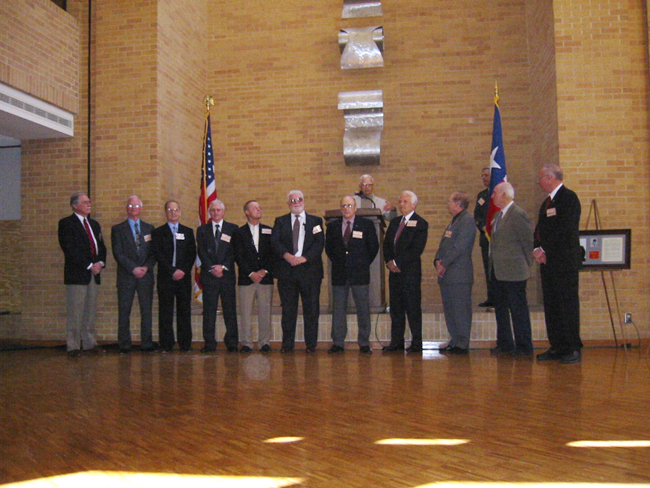
Within the ranks of the Jodies were two distinct elements. One was the serious student who was concerned about getting a degree and a commission (this cadet usually majored in History because of the school’s reputation of an easily obtainable degree.) Typical of this “Type One” element were guys like Jerry Houston, Joel Ward, Gary Weber and Rex Latham, all corps leaders, good students, and future Hall of Honor inductees.
The other element of the Jodies was nebulous in nature, somewhat eclectic. These were the risk takers, the guys who lived on the edge. Most of this “Type Two” element ended up on the Sam Houston Rifles by “happenstance” rather than long range planning. They could care less about grades or learning anything in college. They had no real plans other than to have a good time and hopefully obtain a commission. Non-directional, with no real achievement goals, this group included guys like Doug Welch, Mark Lamkin, George Garrett, Ron Watson, Doug Dulaney and Larry Pitz. The common thread between the two elements was the dedication to the Jodies, and wanting to be the best in the world at something. There would be no Hall of Honor inductees out of the “Type Two” group (even though Welch and Garrett would become Army Colonels and decorated Green Berets.)
A “Mission” was needed to rake havoc on the fraternity life style. An unlikely “leader” of any clandestine mission emerged: Bunky Garonzik. After high school, Bunky lived and worked in the oldest and most dangerous area of New Orleans. To put things in prospective, his rent was $7 a week. He was “street smart”, authority snubbing, totally independent, and never considered the consequences of his actions. His mentor was Ron Rendleman (later became a helicopter hero in Viet Nam). Ron had first hand knowledge of the famous “105 Simulator between the walls at Davis Hall” incident. His reputation was legend, beginning at 16, with the attempt to use his brand new cutting torch to cut down the flagpole at Highland Park High School, along with Charles Klemme and Fred Yarbrough (all future Jodies).
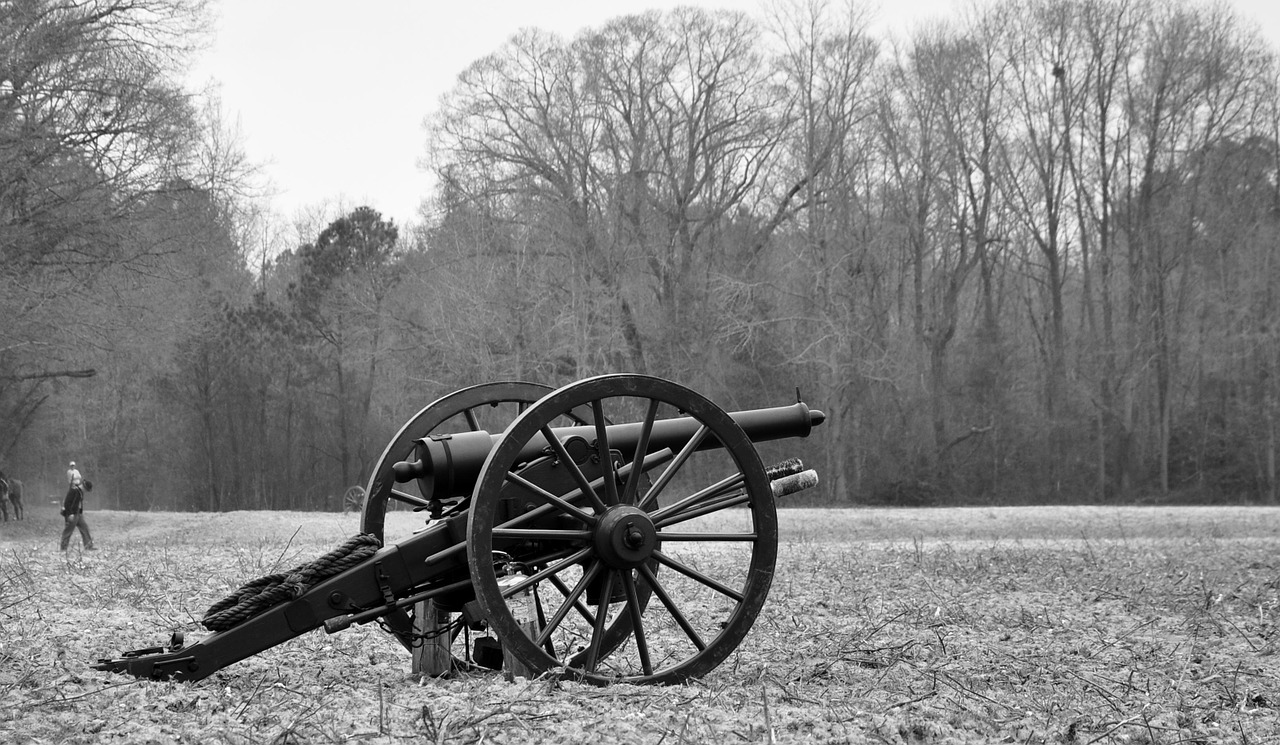
The Kappa Alpha Fraternity at North Texas State University was picked as the target. This was not a random target. This route step, anti military group of party mongers had the audacity to have an authentic military cannon in front of their dormitory. Here was a true contradiction in terms, and a spit in the face of anyone in uniform. Their cannon was going to vanish!
A recon mission was first necessary. G2 (military intelligence) revealed that a pledge slept by the window overlooking the cannon, with a 12-gauge shotgun. The cannon, intact, weighed over 1200 pounds. The mission was becoming complicated, but the cannon must go. The uniform consisted of blackened faces, Jody jackets reversed to the black inside, and black berets. Necessary tools were brought to disassemble the cannon that lay only a dozen steps from the dormitory. Assignments were given, and the raiding party practiced until they were as efficient as a Roger Penske pit crew. Vehicle allocations for each part of the cannon were made, and silent hand signals rehearsed. A sworn oath of secrecy about the mission was taken. In Denton, the mission went flawlessly. In less than 7 minutes, the cannon was heading back to Arlington. One thing was overlooked–where was this fully operational, huge piece of military hardware now going to go?
Once reassembled, the cannon completely filled Bunky’s third floor dormitory room on C ramp at Davis Hall. No problem, no one used the room to study anyway. The barrel alone weighed over 800 pounds, and the wheels stood nearly 5 feet tall. By three in the morning the solid brass barrel shined like a new penny, and the raiders admired their night’s work.
Ben Franklin once said, “Three can keep a secret, if two are dead!” By 8 am, half of the Corps of Cadets were lining up to view the trophy. No one can confirm that the C Ramp Commander, Dave (Possum) Murray informed the authorities, but by 9 am the cops were swarming, and the cannon was once again taken apart, and this time, reassembled on the roof of Davis Hall. The SWAT Team informed the Cadets, “We know there is a cannon in the dormitory. We will be back in an hour. The cannon WILL be out front.”
One final time, the cannon was taken apart and reappeared, intact, on the front lawn. A wrecker arrived and the cannon headed north. The Kappa Alpha’s now had a shiny cannon in front of their dorm, and Garonzik and others had added a footnote to the ongoing saga of capers at UTA.

[Back to Stories and Legends]

by
Joel H. Ward
Colonel, US Army, Retired

In the late ’50s, as Arlington State College (ASC) transitioned to a four-year college, the two-year ROTC program also changed to a four-year curriculum. With that change, the ROTC program was to send its first class to Summer Camp at Fort Hood in 1960. Those cadets would be the first to attend Summer Camp from ASC between their junior and senior year and then go on to graduate as military officers, U. S. Army second lieutenants. I was one of those cadets. We were unbelievably fortunate to be at the right place, at the right time with the right people. Colonel Kirk P. Brock the Professor of Military Science and Tactics (PMS&T) along with his staff of officers and sergeants were concerned about instilling leadership qualities in their cadets. They wanted to teach their cadets how to excel. They realized that they needed something for the cadets to focus on, a challenge, something nobody else had done.

The Right Place: No one that I knew expected this institution and this ROTC program in the middle of the Dallas-Fort Worth Metroplex to become what it is today. During the change from a junior college to a four year college, ASC remained a branch of Texas A&M for several years before coming a permanent branch of the University of Texas. Today, it has grown to be an important branch of the University of Texas system and has the finest ROTC program in Texas. This growth began when ‘we were just cadets’.

The Right Time: As cadets we were the lucky ones who were there to receive the benefits of these academic and military program changes. I don’t think any of us realized until later, how fortunate we were.

The Right People: Few, if any, of us cadets were aware of the quality of the military instructors headed by Colonel Brock, a highly decorated surviving POW from the Korean War. He was supported by assistant PMSs Majors Oliver A. Hord and Charles T. McDowell, and Captain Willard Latham. Captain Latham was the newest addition to the ROTC staff. He too was a veteran of the Korean War, handsome and highly decorated. At 32 years of age he turned the heads of many coeds. He was also an alumnus of ASC and its Corps of Cadets. While a cadet he had risen to the rank of Cadet Colonel as commander of the Corps of Cadets and he also had commanded the Sam Houston Rifles. Now assigned as an Assistant PMS&T, he immediately became the tactics and physical fitness instructor. He conducted physical training and also field training in the hilly area on the north side of Arlington, challenging the cadets’ tactical and physical ability by running us hard over the rough terrain. Frankly, I did not understand why he was so tough and dismissed it that he was just that way. I would learn later that he had a good reason.

We were the cadets that comprised the transition class from the junior to senior ROTC program and the first to go to Summer Camp in 1960. We were the cadet leaders of the corps of cadets when we were sophomores. As juniors we again were the cadet leaders. After Summer camp we would return to continue to lead the corps. Later I began to understand how important that was for us when we went on active duty. Little did we know that three years of cadet leadership experience placed us well ahead of our contemporaries from other schools. When confronted with real leadership issues, we could handle them without hesitation, because we had done it before.

The instructor team under Colonel Brock’s guidance devised a plan to make the cadets believe that they thought of the march to Fort Hood themselves. The instructors thought it worked. The cadets had a different point of view. I expected that we would ride a bus to Fort Hood like we did when we went on trips to performances like the two Junior Rose Bowls with the Sam Houston Rifles. Some how the word came out that Captain Latham was going to lead some cadets on a forced march to Fort Hood. “March to Fort Hood?” we exclaimed, “That must be over a hundred miles.” In fact it was 160 miles. As I remember, Captain Latham expected us to volunteer. Like a military professional that I hoped someday to be, I guess I did. But I did not think for a minute that I thought of the idea myself. Neither did fifteen other cadets. Sixteen out of twenty-eight camp bound cadets “volunteered” to march 160 miles to Fort Hood, near Killeen. The next thing I knew, we were spending weekends on twenty-five mile ‘practice marches’ and running to and from the physical training site at a farm north of town to toughen us. Captain Latham often would arrange a brief church service before the march on Sunday.

As the academic year neared its end, our physical fitness improved, despite our private objections. We would never complain about it in Captain Latham’s presence. Doing that might result in pushups, running laps, or worse. Toward the end of the spring semester of 1960, the junior class, called MS (Military Science) IIIs, was very fit and preparing to go to Summer ROTC Camp. Then came the day. On June 11, after families and girl friends said goodbye, Captain Latham, as march commander, with sixteen of us, in military fatiques, web harnesses and pistol belts, canteens, ponchos, and combat boots, marched south on Cooper Street continuing along State Highway 157. Little did we know that we were doing something never done before. None of us considered that this would become a piece of university lore. We certainly did not know what was in store for us during the next five days because we were just cadets.

Day One – Saturday, June 11th: We marched on the shoulders of the road most of the time. The reflection of the sun’s heat, off of the pavement, made it hotter. With Captain Latham setting the pace, we jogged down and walked up hills. We would take 10 minute breaks every two hours, but soon none of us wanted the breaks because our muscles would cramp up on us. With 33 miles completed, the cadets camped the night in Joshua, rolled up in ponchos on a school ground.

Day Two – Sunday, June 12th: The team continued the march at 5 AM after policing (cleaning) the school ground in Joshua, trekking 6 miles to Cleburne, and having breakfast at a local café. Shortly after we resumed the trek, Billy Clark had to drop out of the march due to blistered feet. He had not been able to join the toughening preparation marches. Major Hord was our support. He ran supply and support runs for the team and carried our bedrolls in a carryall. In this case he served as the ambulance to evacuate Billy back to Arlington. That day was extremely hot, and we made it worse by listening to a radio commercial about refreshing ice tea. We stopped more often to rest because of the sweltering heat. Zack Prince later learned that a very unusual heat inversion, a column of heat that flows to the ground blistering grass, crops, and any vegetation beneath it, occurred near the little town of Rio Vista as we marched through it. It was a good thing we did not know about it at the time. We continued down highway 174 toward Lake Whitney where we planned to camp that night. About ten miles out of our camp sight we encountered a rainstorm drenching all of us to the skin. We camped at night near Kimball Bridge. A couple of cadets cooked veal cutlets and a few innocent by standing grasshoppers for the team. I remember how good it tasted. That night we tried to dry our clothes and equipment by building fires and hanging our damp fatigues on limbs over the fires. Mike Marsh awoke the next morning to find that his shirt had fallen into the fire.

Day Three – Monday, June 13th: The team was up early and continued to Lake Whitney where Captain Latham permitted us to take a swim. It felt so good. Despite this relaxation, we were sore and it was very hard to get up and hit the road again. Our feet were blistered from walking the gravel shoulders of the highway. Mike Marsh wore his poncho over his shoulders to avoid sunburn until Major Hord could bring a new shirt from Arlington. We breakfasted at a restaurant near Meridian. Gene Weidemeyer was the next casualty. He pulled a tendon and was unable to continue. We jogged down a hill to lunch at a roadside café. Captain Latham had reminded us that we must act like officers and gentlemen when we went inside. Bob Darrah was so hot and thirsty that when the waitress did not offer any water, he proceeded to the counter, picked up a frosty pitcher filled with ice and water and proceeded to gulp from it while the ice and water streamed down his fatigues. All the cadets broke into hysterics as the good captain scowled, but did not say a word. Needless to say, Captain Latham was not elated. Later, we completed 21 miles to Meridian. Before we jumped into our bedrolls, we chopped up six watermelons and made them disappear in record time. That night, there was a heavy dew making all of our gear wet again.

Day Four – Tuesday, June 14th: The team breakfasted at a restaurant near Meridian. Major Hord informed us that we were being reported in all of the metroplex newspapers. Someone bought a newspaper and passed it around. We felt good that the folks from home were following our progress. As we passed though Meridian, several old timers, sitting in the shade in front of a little country store, were asked by Robert Roten what the temperature was. One of them replied that it was 103 where they were in the shade, but most likely hotter than that on the road where we were. Now we had to make it to Fort Hood. We also learned that the good people of Gatesville were planning a reception for us. My boots were becoming extremely uncomfortable. During a break Captain Latham, in his role as leader and medic, asked me how I was doing and inspected my feet. My big toes were badly blistered and hurt to the bone when I took any steps. He asked me if I wanted to quit. I considered it, but I just couldn’t. “I’m OK, sir.” I said. I was determined to gut it out. Later, during Summer Camp, my two big toenails would fall off and new ones would grow back. I was not aware the Captain Latham was also suffering from severe blisters. Art Cleveland was caring for him and several other cadets. Many years later, Dr. Art Cleveland in talks on leadership would comment, “Even future generals are not immune to blisters.” Ed MacConnell was quoted that day in the news saying, as he looked at his blistered and tired feet, “It seems to me that the human body was designed to operate on four instead of two.” The Star-Telegram city editor had suggested that one of the reporters, Ed Johnson, join our march for eight miles that afternoon. We asked Ed if his boss liked him. We continued and covered 25 miles nearing Turnersville. Camping in the open close to the road, another storm unleashed its wrath on us just before midnight making us move under a bridge. We were just barely asleep again when a strobe of light broke our slumber. It was a farmer with a flashlight and a shotgun. He suspected us to be escapees from the reformatory at Gatesville. As luck would have it, Major Hord had stayed with us that night, carryall and all. I believe if Major Hord had not assured the farmer that we were not escapees, that he would have held us hostage until the highway patrol came to get us. Major Hord convinced him to let us continue. As he left, the farmer said that he had, in his time, turned in six escapees. He must have felt he had hit the escapee jackpot when he found us. With all these interruptions, our night was blown.

Day Five – Wednesday, June 15th: We were up and moving at 4 AM enroute to Turnersville. We stopped at the town’s only café for breakfast. It was so small that all of us could not get inside. The owner, Mrs. Wallace, took us to her home where she prepared a feast including the best biscuits I have ever tasted. Someone made a school’s shower facilities available which was an unexpected treat. Back on the road, we covered only 17 miles that day, arriving in Gatesville to a huge and warm reception. We were greeted by Alfred H. Hopkins, the Gatesville Chamber of Commerce manager, who personally served us a tub of cold lemonade. County judge, Norman Stone placed the city’s facilities including its park and swimming pool at the cadet’s disposal. As we settled our camp in the park, local teenagers had their own reception planned. In several cars, they repeatedly drove through the park yelling obscenities and driving onto the grass. We were road weary and not in a good mood. Finally, led by Roger Kannady, the cadets armed themselves with empty Coke bottles found by Gerald Osburn. They deployed at strategic ambush locations ready for the “enemy’s” next pass. When the cars came, they were clobbered. The cars disappeared into the town never to be seen by us again. The harassment stopped. We guessed that the body shops would be doing a good business. We bedded down for the last night on the march. We were only eight miles from our destination.

Day Six – Thursday, June 16th: We marched out of Gatesville at daybreak penetrating deep into Fort Hood. On this final day, the temperature was cooler, but the dirt trails were dusty and hilly. With shoulders back, we marched proudly down that last hill loudly singing jody chants. Most of us were numb as we completed the 160 mile journey arriving at the designated crossroads. We were met by Fort Hood Commander, Major General (two stars) Edward G. Farand, who arrived by helicopter, a welcoming party, and the press. Even Captain Latham was smiling with pride. “I am very pleased. I feel there is nothing that these boys can’t do,” he proudly said. Yes, he was proud of us and we were proud of ourselves. Of the sixteen cadets who started the march 14 completed the 160-mile saga. Not bad for ‘just cadets’ who were lucky enough to be at the right place, at the right time, and were taught, mentored, and, yes, even loved by the right people.

EPILOGUE
After the roadside celebration and photos, we were bused to our different company barracks. Arriving two days before camp formally began, we showered, rested, ate, and became familiar with our new home for the next six weeks. The Fort Worth and Dallas newspapers reported, “General Greets Tired A.S.C. Men” and “Snappy Cadets Complete Long Trek”. One statement in the Star Telegram was, “Reliable sources say that some money changed hands in Arlington Thursday, the lucky ones are those who knew that these cadets are winners.”

I now realize that we were lean, gaunt, had dark tans, and, I am told, looked pretty tough. Twenty-three years later when I had returned to UTA as the Professor of Military Science, Dr. Walt Mullendore, then Dean of the School of Business, mentioned that he remembered us at camp. He was a cadet from another school in the mid-west. He commented that the word was out among the 3000 other cadets at camp, “Don’t mess with the ASC boys, they are tough.” I don’t know about tough, but Captain Willard Latham and all of the military instructors had done a great job with a bunch of guys from “that little junior college in Arlington.”

Willard Latham distinguished himself and UTA in his military career by eventually rising to the rank of Major General.

Of the total 28 cadets from ASC attending Summer Camp, 19 returned home as Distinguished Military Students with recommendations from the camp commander for Distinguished Military Graduate (DMG). Being a DMG opens the door for a cadet to become a Regular Army Officer with strong career potential. The ROTC program concluded its Cinderella year in grand fashion.

On a personal note, this experience gave me the confidence to draw upon in combat when under hostile fire in Vietnam. When my radioman was hit while we were hip deep in rice paddy water, I had the confidence to know that I could carry him and his radio to safety. Without that experience of the march which made one push beyond his known limits, we both might not be here today. I can never repay those officers and sergeants who molded us into what each of us became. I will be eternally grateful. I am sure the others feel the same.
END

Here is a list of the marchers:

1. Billy Clark
2. Arthur G. Cleveland
3. Bob Darrah
4. James Hunter
5. Allan E. Jenson
6. Roger Kannady
7. Ronald W. King
8. Ed MacConnell
9. Michael Marsh
10. Gerald G. Osburn
11. Billy Bob Pinkerton
12. Zack Prince
13. Ronald Rendleman
14. Robert Roten
15. Joel H. Ward
16. Gene Weidemeyer


The winds of wars were swirling in Europe. Germany had overrun Poland. The Soviet Union had just invaded Finland. The Great Depression was in full force, and the U.S. national unemployment rate was 17.2%. The year was 1939, the month late November. Arlington was a small rural town surrounded by cotton farms. Just south of the town, was the North Texas Agricultural College (NTAC, forerunner of UTA), a part of the Texas A & M System. On the NTAC campus, the students (all male students were cadets) were at fever pitch, preparing for the coming battle, not the war in Europe, but the big football game with John Tarleton State College (JTAC), a sister institution in the Texas A & M System (now Tarleton State University in Stephenville).

The rivalry between the two schools was intense, partly because of history and tradition, partly because the cadets had few other diversions. Most of the students were desperately poor and could not afford off-campus entertainment of any type. BY 1926, the rivalry between the two schools had become so “spirited” that the two schools cancelled all scheduled football games from 1927 to 1933. The football rivalry resumed in 1934, apparently without any loss of mutual antagonism for the opposing college. Each year, cadets at both schools built a huge pile of logs, scrap lumber, and wooden boxes for a great pre-game bonfire and homecoming celebration to inspire their respective football teams. Students made frequent attempts to raid the other campus and set fire to its “pile” ahead of schedule. According to the Tarleton Student Handbook (which counts this story as one of it’s major traditions), the students were driven by “the desire to cause premature conflagration to the accumulated rubbish.”

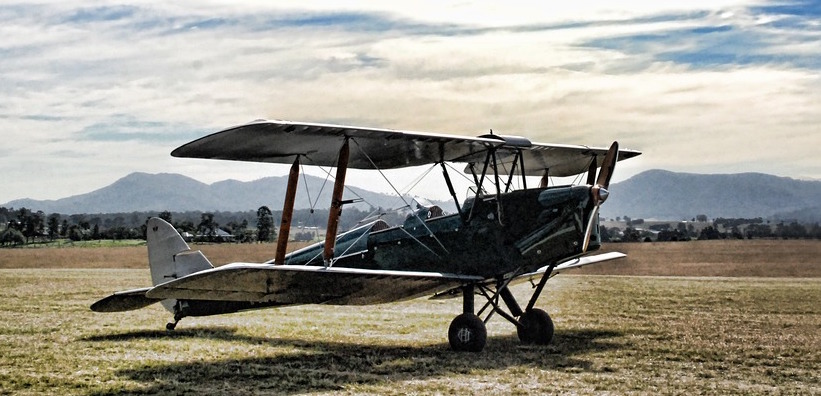
On Monday, November 27, 1939, a raiding party from Tarleton burned NTAC’s bonfire “pile” and then burned Tarleton’s initials into the NTAC football field as an added insult. The students at NTAC were greatly agitated by these hostile actions, and after some “inspirational potions” a large group of NTAC students retaliated. A freshman cadet from Caddo Mills, Chester Phillips Jr., took the lead. Chester happened to be a student pilot. The plan of attack involved both air and land operations, with a coordinated assault.

Selecting cadet James E. Smith from San Antonio as his co-pilot and bombardier, Chester rented a small Taylorcraft airplane (single engine, two-seater), loaded it with a sackful of phosphorous “bombs,” and took off for the Stephenville campus. Simultaneously, three truckloads of NTAC cadets departed by ground. Meanwhile, word of the impending attack had reached Dean Edward E. Davis at NTAC. Alarmed, he telephoned a warning to Tarleton, and dispatched Major Max Oliver, the NTAC Commandant, to bring the errant raiders home.

Tarleton students were lying in ambush to repel the attack. The small plane flew low over the bonfire pile and James attempted to drop the phosphorous bombs on the target. According to some reports, one of the bombs set fire to the Tarleton “pile,” but the defenders quickly extinguished the fire. While most of the bombs missed the wood pile, the sticks and boards hurled up at the airplane did not. One of the Tarleton defenders, L.V. Risinger, hurled a 2X4 into the air. It struck the propeller and brought the small plane down. Chester managed to fly the “wounded” plane over what is now the Hall of Presidents, barely clear a rock fence, and crash-land into a clump of trees. (Or some say, come to a stop three feet away from crashing into the rock wall). Chester and James survived the crash, only to be captured by the Tarleton defenders. Meanwhile, the three truckloads of cadets likewise fell into ambush, and most of the attackers were captured. Each of the captured cadets had a block-T cut into his hair, according to Col. Charles McDowell (a JTAC defender and later the Professor of Military Science at UTA). Several of the JTAC students climbed atop the bonfire pile to make speeches about the “spirit” between the two schools, and to tell their defeated rivals to “take your plane and go back home.” The NTAC boys were treated to hot coffee and doughnuts and set loose to return to Arlington. A picture of the crashed airplane appeared in the next issue of Life Magazine, according to some accounts (but we have not been able to find any issue with the photo).

According to the Fort Worth Telegram, discipline and quiet reigned on both campuses the next day. Chester and his bombardier, James, had to appear before the Federal Civil Aeronautics Authority for a routine investigation into the incident. Dean Davis of NTAC told the Dallas Morning News that, “There is no ill will between the student bodies, but the enthusiasm gets out of hand, interferes with normal school work and might result in an unfortunate accident. It is all in fun now, and no one has been hurt, but such raids as were made by Tarleton boys and the one made at Stephenville Tuesday night by our students could very well result seriously.” He added, “There is a possibility that the athletic contests will be suspended between NTAC and Tarleton.”

The much anticipated football game was held as planned in Arlington, Thursday, November 30, 1939. Arlington’s great opportunity for redemption and revenge reverberated in the stadium, but this was not the year. The Tarleton “Plowboys” beat the NTAC “Hornets” 7 to 0. Afterwards, officials of the two schools held a meeting in Stephenville to discuss disciplinary actions and future relationships between the two schools. Faculty committees of both schools agreed to eliminate the traditional bonfire preliminaries to the annual football game. They also agreed that the 1939 football game would be the last Texas Conference contest for each school. However, athletic relations of the two schools would continue, with faculty supervision of pre-game activity. The matter of disciplinary action toward the student raiders from both schools was left to the individual schools.

NTAC executives ratified the actions of the Stephenville conference and instructed the discipline committee of North Texas Agricultural College to confer with the 30 or so students who were known to have participated in the raid. The discipline committee, which included Dean Davis and Major Oliver, decided to expel James Smith for the remainder of the semester, and to recommend the suspension of Chester Phillip’s flying license for six months to the FCAA for violating flying rules of safety. For the other students there would be a discussion on behavior and a warning against similar activities in the future. At John Tarleton, Dean J. Thomas Davis (the brother of NTAC’s Dean Davis) said that he was not certain that any severe discipline would be meted out.

Chester Phillips, Jr. did not let this incident daunt his flying career. With U.S. involvement in World War II fast approaching, Chester joined the Army Air Corps, as did many of the young cadets at both schools. He trained military pilots, and when the war began in earnest he was shipped out to Shipdam, England. According to a Blackie Sherrod column in the Dallas Morning News, Chester was assigned to a B-24 Liberator, called the “Little Beaver.” German submarines at the time were causing havoc to Allied shipping, and Chester’s mission in May of 1943 was to destroy the submarine pens at Kiel. He and his crew encountered German fighter planes and heavy anti-aircraft flak. Chester and several of his crew were killed instantly. Others bailed out and were held as POWs for the rest of the war. Chester is buried somewhere in Belgium.

Many of the other bonfire raiders and defenders also served their country well and still remember the incident. Col. Charles McDowell, now in the UTA Foreign Language Dept. (Soviet Studies) was one of the JTAC bonfire defenders who helped to bring the plane down. He remembers his group of defenders throwing everything that they could get their hands on up at the plane as it came over. L.V. Risinger, the young man reportedly responsible for the successful 2X4, became a hero at Tarleton. The present day Homecoming Bonfire is dedicated to him. He died in 1994. James Smith left UTA and almost assuredly fought in World War II, although his trail has been lost.

Aaron Williams, a native of Greenville and a relative of Chester Phillips, told Blackie Sherrod that “If Chester were here, he probably would get a good chuckle to know that people are still talking about his airplane antics.” Chester and all the others who participated in the abrupt ending of the flight would also be amazed at the variety and the disparity in the details remembered and recounted over time.

X